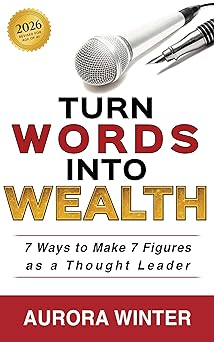
What if the most expensive mistake in business isn’t failure—but explaining your brilliance badly? In Turn Words Into Wealth by Aurora Winter, discover why clarity may out-earn genius. Read on.
Turn Words Into Wealth by Aurora Winter
Genre: Nonfiction
Sub-genres: Business Strategy, Personal Branding, Entrepreneurship, Media & Publishing
Themes: Storytelling, Authority, Reinvention, AI-era positioning, Strategic Communication
Review
Most people believe success hinges on talent, timing, or relentless work. Aurora Winter suggests something less glamorous but more powerful: words. Specifically, the right words.
In Turn Words Into Wealth, Winter argues that the difference between obscurity and influence often comes down to positioning. Not hustle. Not credentials. Not even innovation. Messaging.
The book unfolds as both memoir and manual. Winter shares her journey—from building a yacht dealership around a seven-word slogan to transforming personal tragedy into a coaching movement, and later into a publishing and brand strategy firm. These stories are not confessions; they are case studies. Each turning point hinges on a shift in articulation. The idea existed before the success. The breakthrough came when the message sharpened.
Cognitive science supports this premise. Studies in behavioral economics show that framing significantly affects decision-making. A product described in emotionally resonant terms can outperform a technically superior one explained poorly. Winter leans heavily into this psychological truth: people respond to narrative clarity.
The structure of the book is pragmatic. Readers are guided through identifying a “Million-Dollar Message,” constructing a brand narrative, leveraging media platforms, and launching strategically. There is emphasis on thinking like a “showrunner”—someone who orchestrates content ecosystems rather than merely producing isolated outputs. The AI discussion is not alarmist; it positions artificial intelligence as a tool that amplifies clarity rather than replacing human originality.
The examples are contemporary: Taylor Swift reclaiming masters, Alex Hormozi leveraging live launches, J.K. Rowling retaining digital rights. These are not random celebrity references; they illustrate ownership, distribution leverage, and strategic storytelling.
The book will resonate most with entrepreneurs, consultants, authors, and professionals seeking visibility. It is for people who suspect their expertise is undervalued but cannot articulate why. It is not for readers seeking a purely literary experience or deeply academic treatise on branding theory. Nor is it ideal for those looking for minimalist business advice. Winter’s style is expansive and example-driven.
One might question whether every cited revenue figure is exhaustively sourced, and the tone occasionally borders on motivational intensity. Yet the frameworks themselves are coherent and implementable. The recurring thesis—that clarity compounds—is difficult to dismiss.
An unconventional strength of the book is its integration of grief into business philosophy. Winter does not separate life from enterprise. Reinvention is presented as both economic and personal. That layered perspective gives the book depth beyond standard branding manuals.
If there is a central takeaway, it is this: expertise without articulation is invisible. And invisibility is expensive.
For readers ready to refine how they communicate value, this book offers both encouragement and structure. For readers content to remain technically proficient but strategically silent, it may feel unnecessary.
Clarity, Winter argues, is not decoration. It is leverage.
Content Warning
The book briefly discusses death, grief, and suicide in a non-graphic, educational context.
Share Your Insights
Feel free to share your answers in the comments below:
- What part of this post resonated with you the most, and why?
- How does this post connect with your own journey?
- Do you have any other bookish insights you’d like to share?
Disclaimer
The content in The Bookish Magazine is for general informational and literary purposes only and does not constitute professional advice. Opinions expressed are those of the authors and do not necessarily reflect the views of the publication. For full details, please read our complete disclaimer, terms, and policies on our website.
Helpful Shortcuts
- About
- Books and Blogs
- Contact Us
- Disclaimer, Privacy Policy, and Terms of Service
- Editorial Guidelines
- Magazine
- Submissions
- The Bookish Awards
- Voluntary Contribution Policy


