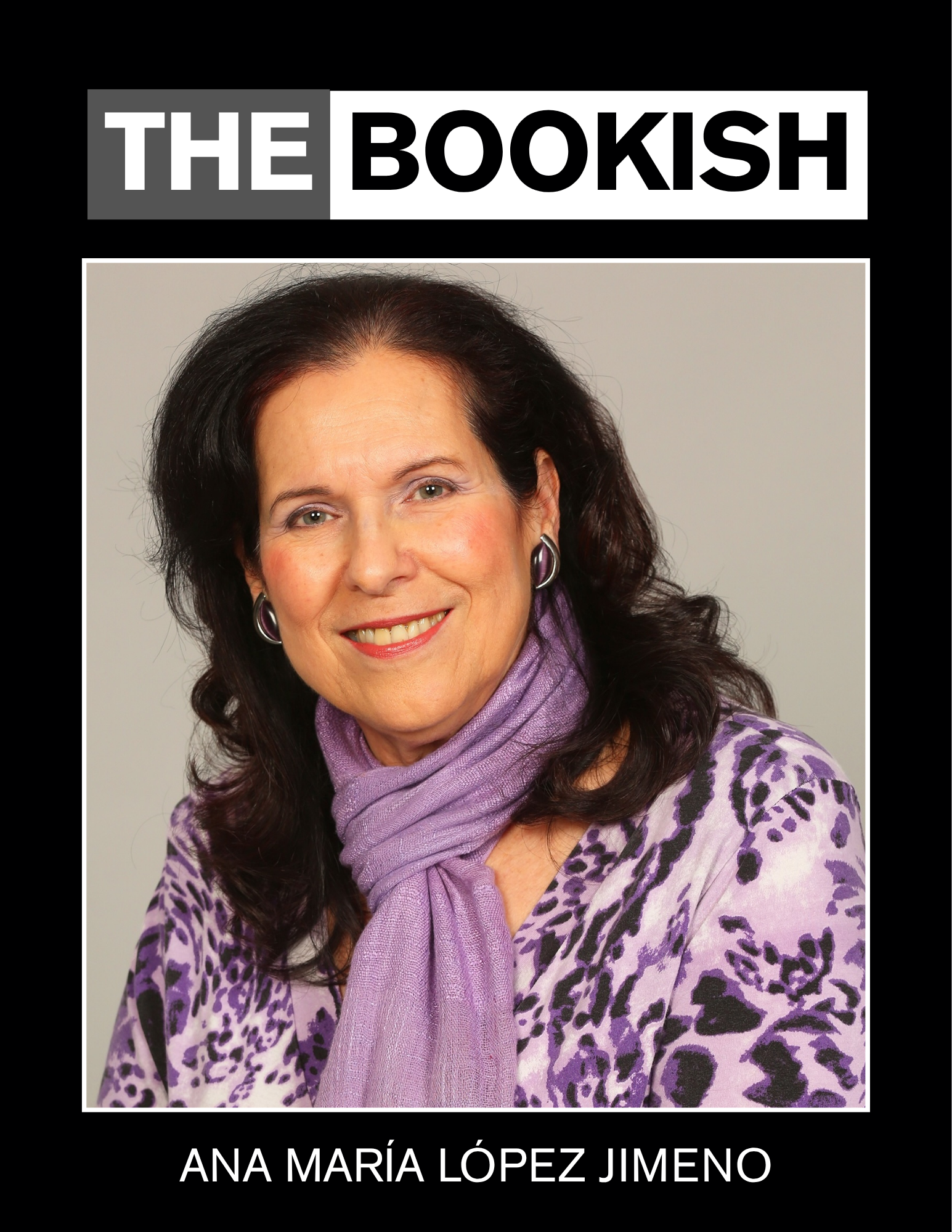
Ana María López Jimeno, educator and author of Vademecum of English, explores language learning through phonetics, grammar, vocabulary, and etymology. Drawing on decades of teaching experience in Spain, she discusses multilingual education, structured learning systems, and her reference guide, which has received multiple international book awards including the BREW Nonfiction Book Excellence Award 2026 (Linguistics Category).
Could you introduce yourself, share your background, and tell us about your work in language education and what you hope to achieve through it?
I grew up in Puerto Rico speaking both Spanish and English, and early on I understood that every language you learn doesn’t just give you new words — it gives you a different way of reading the world. That took me to Spain, where I started studying Spanish Philology at the UAM — until an Arabic course in the curriculum changed everything. Arabic is a fascinating language, tough but very beautiful, and works in a completely different way to English and Spanish. So I switched to Arabic Philology and started a never-ending curiosity spree on languages, studying and comparing many of them throughout my career.
After finishing my degree, I moved to Toledo, where I opened a language academy and the first English kindergarten in the city, and spent more than four decades teaching English, Spanish, and Arabic. My next language challenge is Euskera.
The Vademecum of English is, in many ways, the distillation of all those years: a comprehensive single-volume reference covering English phonetics, grammar, vocabulary, etymology, and morphology. I built it because the resources I needed when I started learning and teaching simply didn’t exist or were scattered among many books, grammars, and dictionaries. I needed all the information gathered in a single place. Now I’m preparing my Doctorate in Didactics of Languages — partly to give the scientific framework to what four decades in the classroom have already shown me in practice.
What I hope to achieve is concrete: to make language learning more effective, more accessible, and less frightening — for students and teachers alike. Learning a new language should be an exciting adventure, not an obstacle race.
What first inspired you to focus on language teaching and the development of structured learning resources?
Necessity, mostly. When I started learning new languages myself, I found that most available methods were not built around the way people actually acquire language naturally. They prioritized reading and writing over listening and speaking — which is precisely the opposite of how every child in the world learns their mother tongue. I kept looking for a method that followed that natural sequence, and when I could not find one that satisfied me, I started building my own.
The structured resources came later, as a response to a different problem: I realized that teachers were spending enormous amounts of time preparing materials from scratch, often reinventing the wheel with every new class. If I could give them a reliable, complete system, they could invest that energy where it truly belongs: in their students.
Your work emphasizes the interconnectedness of phonetics, grammar, vocabulary, and etymology. How did you develop this integrated approach?
It came from years of asking the same question: why do so many learners study English for years and still can’t hold a conversation? The answer, almost always, was fragmentation. They had learned isolated pieces: grammar rules with no connection to real speech, vocabulary lists with nothing to anchor them, pronunciation treated as decoration rather than function.
The Vademecum is structured around the idea that these elements are not separate subjects but the same system looked at from different angles. Phonetics determines how words sound and how they are retained in memory. Etymology explains where words come from and why they behave the way they do — what I call ‘etymorphology’, the intersection of etymology and morphology — and gives learners permanent tools to decode unfamiliar vocabulary rather than memorising each word in isolation and with nothing concrete to connect it with. Grammar explains the logic of how those words combine, not just the rules but the reasoning behind them. And vocabulary is organised in semantic families of twenty items, because that is roughly the number of words you might need to know in any specific field to start learning a language.
Also, in the teaching routines we apply later, those 20 items are delivered in groups of 4 items, which is the number of words that the brain can retain as new material without experiencing cognitive overload.
The integration is not a pedagogical choice — it reflects how language actually works.
How do you balance academic rigor with accessibility when designing materials for learners and educators?

By always asking the same question: does this explanation help someone use the language, or does it just describe it? There is a significant difference between knowing a rule and being able to apply it under pressure in a real conversation.
I am what I would call a ‘one-pager obsessive’: I try to concentrate all the relevant information on a single page, clearly organized and visually structured. If I cannot explain a concept that way, I go back and rethink the explanation, not the format. Academic rigor means finding the most honest and logical explanation for how a language works. Accessibility means presenting it in a way that does not intimidate the person who needs it most.
The two are not in conflict. Complexity can always be made clear — it just requires more work from the author, not more effort from the reader.
Many language learners struggle with irregularities in English. How do you approach explaining complexity in a way that feels manageable and logical?
Languages are systems, and systems require logic and order to work. I start from the premise that very few things in language function are truly arbitrary — most irregularities have a historical or etymological explanation. When learners understand why a form exists, it stops feeling like an obstacle and starts feeling like a piece of the puzzle.
Etymology is enormously useful here. English, besides its Germanic roots and more common words, has absorbed a huge vocabulary from Latin, French, Arabic, and many others, and each of those layers follows its own internal logic. Teaching learners to recognize those patterns — prefixes, suffixes, roots — turns apparent chaos into a navigable and understandable system.
I also believe in being honest with learners: some things simply need to be memorized, and that is fine. But I try to minimize those cases by giving context wherever possible, and by sequencing the material so that complexity builds gradually on a solid foundation rather than overwhelming the learner from the start.
Your book has been recognized as a recipient of a BREW Nonfiction Book Excellence Award 2026. Could you share your perspective on this recognition and what it means to you?
It was a very exciting and joyful moment, given the level of rigor that the BREW Project devotes to its judging process. The fact that the book could get through all their layers of scrutiny really validated the project and rewarded a long journey.
The Vademecum of English was never planned as a book; it grew organically from decades of reading, analyzing, and compiling everything I wished I had found in a single resource when I was learning and teaching. When I finally had all the subjects organized, I decided to publish it as a tool for teachers and curious learners alike.
Receiving the BREW Nonfiction Book Excellence Award 2026 — a recognition specifically for nonfiction works of academic and educational value — confirms that the gap the book was trying to fill is real and widely felt. This award, together with the BREW Seal of Excellence and the recognitions received in the United States and Australia, tells me that what started as a private working document has become a reference that resonates far beyond my immediate professional context. That is more satisfying than any individual prize.
Your work appears to support bilingual learning environments. How do you see multilingual approaches enhancing language acquisition?
Speaking several languages gives you something that is very difficult to develop otherwise: the ability to see language as a system rather than as a natural environment. You stop being inside the language and start being able to observe it from the outside. That shift changes everything about how you teach.
In practice, it means I use contrastive grammar deliberately — placing English structure alongside Spanish or Arabic makes the differences visible and logical rather than arbitrary. That is the principle behind the Graphic Grammar I have designed: a system that represents grammatical functions and relationships through geometric shapes — along with size, colour, and position — allowing learners to compare sentence structures across languages at a glance. It removes the dependency on metalinguistic terminology, which is particularly useful for learners who have had limited formal instruction — but it also works as a precision tool for advanced learners and researchers who want to analyse the same construction across multiple languages simultaneously.
The cognitive argument is well established: every language you know accelerates the acquisition of the next. The mechanisms of one become the reference frame for understanding another.
What challenges have you encountered in creating teaching frameworks that work across different learning styles and backgrounds?
The hardest challenge isn’t technical — it’s design. You have to build something that works for a professional linguist and for someone who has never been in a classroom, without either feeling the material isn’t for them.
My solution was layered access. Visual tools and one-page summaries are the entry point for learners without a formal background. The etymology sections, derivational morphology charts, and analysis of the English verb system are there for those who want depth. A good teacher knows which layer to work in with each student — the material just needs to be there when they need it.
The other persistent challenge is pacing. As I mentioned before, I deliberately limited vocabulary groups in the Vademecum to twenty items per set, looking for the most frequently used and commonest words to ensure usability. Grouping them semantically ensures a better understanding and maximizes retention. Small, consistent steps build more durable knowledge than large irregular ones — and that principle shapes the architecture of the whole book.
Looking back on your professional journey, what milestones or accomplishments have been most meaningful to you, and how have they shaped your direction?
Publishing the Vademecum was a milestone I hadn’t planned for. For years it existed only as a working document — a private archive of explanations I had built for myself because I couldn’t find them elsewhere. The decision to publish it was the decision to find out whether the problem I had been trying to solve was mine alone or shared by others. The response has been clear: gold medals from the Independent Press Award, the International Impact Book Awards, the Pacific Book Awards, and the President’s Book Awards of the Florida Association of Publishers and Authors, among others, plus the BREW Nonfiction Book Excellence Award 2026. Each one confirmed that publishing the book was a positive decision.
My other current enterprise is Lexiway® Online, a teaching platform to help teachers deliver their language classes (available in Spanish and Catalan right now, with more languages to come), where they can find all the material they need, structured sequences, and progressive lessons covering the required curriculum. Although it is intended for absolute beginners to achieve what we call a “minimum survival level” as quickly as possible, it can be used for other levels. It focuses on phonological awareness from the start to help students master all the sounds of the language. This yields enormous benefits in the long run and should be the starting point when learning a new language.
So, combining both experiences, the other milestone in sight is my Doctorate in Didactics of Languages at the Faculty of Education of the Universidad Autónoma de Madrid. After four decades of applied practice in the classroom, building the scientific framework for what I have observed empirically has forced me to challenge assumptions I had held for years — and in several cases, to find that the evidence supports them more strongly than I had expected.
As language education continues to evolve, what areas of innovation or improvement do you think will be most important in the coming years?
Four things, all of them connected to how we think about reference and knowledge in language teaching.
First, the order in which languages are taught should be reversed. Teaching reading and writing without knowing oral expression is simply nonsense. It is unnatural and goes against any logic, making the process burdensome and more difficult. People want to use the language orally to get around and communicate. The rest is desirable but secondary.
Second, the shift from rule-based to reason-based instruction. The next generation of language teachers needs resources that explain the logic of a language, not just its conventions. The Vademecum was built on that premise, but it needs to become the standard, not the exception. Learners who understand why English works the way it does are more autonomous, more resilient when they encounter unfamiliar structures, and more capable of self-correction.
Third, the integration of etymology and morphology into mainstream teaching. These disciplines are treated as specialist territory when they should be foundational. A learner who understands derivational morphology — how prefixes, suffixes, and roots combine — has a self-expanding vocabulary. And it follows the Matthew Effect: the more roots and affixes you know, the deeper and wider your vocabulary will become. That is one of the most underused tools in language education today.
Lastly, teacher training should focus both on subject knowledge and delivery methodology. The depth of linguistic knowledge a teacher needs to answer the questions a serious learner will ask is absolutely necessary, but so are the pedagogical techniques that allow teachers to deliver it. The better the teachers are, the better students we will have. Teachers are the keystone of education.
If you were to write your own bio, what would you say? And as your work evolves, what kind of impact do you hope it has?

Ana María López Jimeno is a curious linguist, educator, and author with more than four decades of experience teaching English, Spanish, and Arabic across formal and informal settings. Born in Puerto Rico and educated in Spain, she founded a language academy in Toledo and developed the Lexiway® Method — a teaching system built on the principle that language acquisition should follow the same path every child takes naturally: listening first, speaking next, reading and writing much later.
She is the author of the Vademecum of English, a comprehensive reference work covering phonetics, grammar, vocabulary, etymology, and morphology, and the creator of the Graphic Grammar, a visual system for contrastive language analysis. Her work with migrants and refugees through the Spanish Red Cross led to the development of Lexiway® Online, recognised with a Special Mention at the 9th Humanitarian Technology Awards. She is currently preparing her Doctorate in Didactics of Languages.
The impact I hope for is concrete: every teacher who uses the Vademecum spends less time searching for explanations and more time teaching. Every learner who works through it understands not just how to use English, but why it works the way it does. And every researcher or educator who picks it up finds a reference they can return to at any stage of their career. Teaching has always been an act of love. I hope my work shows that.
Share Your Insights
Feel free to share your answers in the comments below:
- What part of this post resonated with you the most, and why?
- How does this post connect with your own journey?
- Do you have any other bookish insights you’d like to share?
Disclaimer
The content in The Bookish Magazine is for general informational and literary purposes only and does not constitute professional advice. Opinions expressed are those of the authors and do not necessarily reflect the views of the publication. For full details, please read our complete disclaimer, terms, and policies on our website.
Helpful Shortcuts
- About
- Books and Blogs
- Contact Us
- Disclaimer, Privacy Policy, and Terms of Service
- Editorial Guidelines
- Magazine
- Submissions
- The Bookish Awards
- Voluntary Contribution Policy


