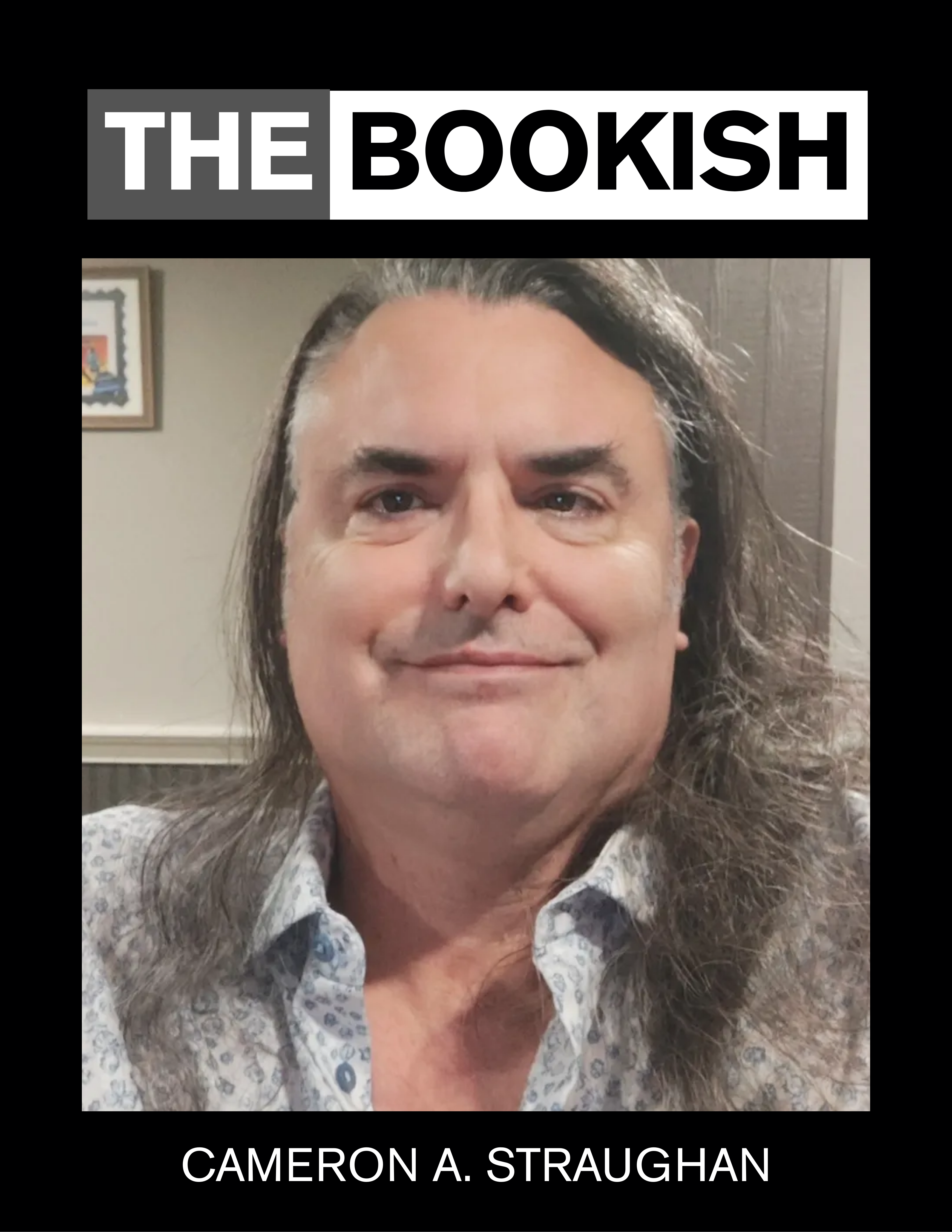
Cameron A. Straughan’s artistic endeavours go into the realm where ordinary existence blends with creativity, humour, and introspection. He considers how humans make sense of routine, uncertainty, and individuality in evolving times through creative storytelling. In this interview, Cameron offers readers a contemplative look at how imagination may uncover significance in unexpected places by sharing his creative process, personal influences, and the experiences that have moulded his storytelling style.
Cameron, thank you for joining us today. To begin, could you introduce yourself in your own words—who you are, what you do, and what currently motivates your creative work?
You are most welcome. It is an honor to share my creative life with you.
I am an award-winning autistic writer whose work blends surrealism, dark humor, and high-concept genre storytelling. I am the author of The Surreal Adventures of Anthony Zen, and my latest screenplay, Schisma, continues my fascination with cosmic horror, identity, and the uncanny. I am also working on a graphic novel based upon a play I wrote, and a children’s book about my character Anthony Zen.
Born in a small conservative town and diagnosed as autistic at the age of forty-eight, I bring a distinct outsider’s perspective to my writing—marked by vivid imagination, clean visual prose, and an absurdist edge shaped by years as a fisheries biologist, educator, and STEM specialist in a First Nations community. I am currently developing a PhD proposal based on my culturally responsive STEM model: Do → Reflect → Explain → Connect.
I am committed to pushing genre storytelling into more inclusive, psychologically rich territory.
Your writing explores everyday life through a very imaginative lens. What originally drew you toward this style of creative expression?
I’ve always been deeply observant, often noticing patterns and contradictions in everyday life that others seemed to overlook. Alongside that came a quirky sense of humor and a natural attraction to unusual, alternative forms of culture. I now understand that much of this perspective is rooted in my autism—something I see not as a limitation, but as a kind of superpower that allows me to see the familiar world from slightly off-center.
Curiosity has always been my main motivation. I’m endlessly fascinated by why people behave the way they do, how systems function (or fail), and how much meaning we assign to things that may not deserve it. Writing became a way to explore those questions—initially as a coping mechanism and, over time, as a form of therapy. It helped me process the world, make sense of it, and find a way to communicate my inner experience to others.
I was also drawn to the challenge of doing something I didn’t see anyone else doing at the time: treating everyday banalities as epic material. I wanted to know whether the ordinary could be transformed into something funny, strange, or even profound. Could waiting in line, workplace routines, or social rules become “adventures”? In many ways, these were stories about nothing—long before Seinfeld arrived—but filtered through an absurd, imaginative lens that revealed just how bizarre normal life really is.
How do personal experiences influence the worlds and characters you create, even when those worlds lean heavily into imagination?
They are absolutely integral. Even when my work leans heavily into imagination, it’s always grounded in lived experience. I’ve worked many different jobs across Canada, in New York, and in England, which has given me a wide lens on how people, systems, and institutions actually function—or fail to.
I’ve worked for consulting firms, a major bank, universities, a wide range of schools, and every level of government. Those environments are already strange, rule-bound, and often illogical, so exaggerating them into the surreal feels natural rather than forced. The absurdity in my writing isn’t invented out of thin air; it’s usually a slight twist on something I’ve already experienced.
Imagination, for me, is a way of distilling experience. By bending reality, I can reveal emotional or psychological truths that might otherwise be ignored. The worlds I create may look bizarre on the surface, but they’re rooted in real encounters, real frustrations, and real moments of quiet wonder.
Many readers find that humor can make difficult or complex ideas easier to engage with. How do you personally approach the balance between playfulness and meaning in your work?
This is a great question because my work lives in that careful balance. The key is to show that the humor isn’t decoration; it’s the delivery system—a spoonful of sugar to help the medicine go down.
I don’t usually think of humor and meaning as opposites that need to be balanced. For me, humor is often the most honest way to approach difficult or complex ideas. Absurdity lowers our defenses. Once we’re laughing, we’re more open, more receptive, and less afraid of uncomfortable truths. Also, more so than taste in music, I think sense of humor brings us together with like-minded individuals. It helps us bond, converse, evolve, and ultimately survive. Humor is serious business.
I tend to begin with playfulness—a strange image, an illogical situation, a deadpan reaction—and let the meaning emerge naturally from there. If I start by trying to make a point, the writing stiffens. But if I let the humor lead, the deeper ideas tend to sneak in on their own. I trust the reader, which can be dangerous (they may completely misinterpret my intentions), but the risk is worth it—and part of the fun.
Ultimately, I’m not interested in telling readers what to think. I’d rather invite them into a slightly skewed version of reality, let them laugh at it, and then leave them with something quietly unsettling or reflective once the laughter fades.
When developing a main character, what qualities do you focus on to make them feel authentic and relatable, even in unusual situations?
I find it fascinating that I’m able to create relatable characters even though, as an autistic person, I’ve often struggled with relating to others or feeling “authentic” in social situations. In many ways, I think I write the way I wish to be seen. My characters become a kind of test pattern—a personal goal, or an imagined version of connection.
Nearly all of my characters are outsiders drifting through life. Some, like Anthony Zen, aren’t architects of change at all. They exist in a Zen-like state, remaining calm as chaos washes over them. They are deep thinkers rather than active participants, observers more than agitators.
That quiet, independent, outsider perspective inevitably seeps into everything I write. At its core, I think my work is driven by a very simple, universal desire: peace and comfort. Writing—and seeing how readers respond to it—has helped me realize that perhaps I’m not as different as I once believed.
Creative work often evolves over time. Looking back at your earlier writing compared to your more recent projects, what changes do you notice in your voice or approach?
Looking back, I think the biggest change is structural rather than tonal. In my earlier work, I was more interested in exploring ideas and moments, often letting them unfold in loose, surreal ways. In my more recent projects—film scripts, a graphic novel, and a children’s book—I’ve been working within more traditional narrative frameworks.
That said, I don’t feel I’ve lost my voice. The absurd, surreal, and satirical elements are still very much there; I’ve simply given them a stronger plot structure to hang from. If anything, the structure has allowed the ideas to land more clearly, while still leaving room for playfulness and surprise.
Every creator faces moments of uncertainty. What habits or practices help you stay consistent and grounded in your creative process?
I don’t really experience writer’s block—I experience writer’s flood. I tend to have too many ideas at once, which can be both energizing and exhausting. To manage that, I often move between projects. It means some pieces take longer to finish because I’ll pause one to follow another, but it also keeps me highly productive and creatively engaged.
One of my most important sources of inspiration is my dream journals. Revisiting them often sparks new ideas or reconnects me with the surreal logic that underpins much of my work.
A bigger challenge for me is self-censorship. In the current climate, I’m very aware that my writing invites interpretation—and once something is interpreted, it can be read in ways I never intended. That risk makes me anxious at times, but it’s also part of what keeps the work exciting. I’ve learned to accept that uncertainty, and even embrace it. I do like to surprise—and occasionally shock—my audience.
Readers often enjoy discovering the messages they take away from a story. What kinds of reflections or takeaways do you hope your work naturally encourages?
I don’t approach my work with a message I want to deliver so much as a space I want to create where readers can freely reach their own conclusions. If readers take anything away from The Surreal Adventures of Anthony Zen, I hope it’s permission—permission to slow down, to laugh at the strangeness of everyday life, and to stop assuming that everything needs to make perfect sense.
Anthony doesn’t conquer chaos or rise above it; he simply moves through it without panic. I hope that invites readers to reflect on how much energy we spend trying to control, explain, or perform our way through life, and how freeing it can be to let some of that go.
At its core, the book gently suggests that calm can be a form of rebellion, that being “out of step” isn’t necessarily a failure, and that there’s value in observation, curiosity, and humor—even when the world feels fragmented or overwhelming. If readers come away feeling a little lighter, a little less rushed, or more accepting of life’s absurdities, then the stories have done their job.
Many artists experience milestones that shape their perspective. Without listing them for you, would you be willing to share any recognitions, turning points, or meaningful milestones in your creative journey, and what they meant to you personally?
I have a strong long-term memory, which means I can trace my creative journey back quite far—though I admit I’m naturally quiet and somewhat uncomfortable highlighting milestones. Still, a few moments stand out clearly.
The first recognition I ever received for my writing was in grade five, when I read an absurd short story about searching for Bigfoot to my class. They roared with laughter. A few years later, I read a spy adventure story aloud to a difficult, indifferent grade eight class. When I finished, there was a long, uncomfortable silence—until I awkwardly said, “That’s the end,” and the entire room burst out laughing. Those early experiences showed me not only that I could write engaging stories, but that performance mattered. That realization later shaped how many of the Anthony Zen stories were first shared—aloud, in front of an audience.
One thing I’ve come to appreciate is that no experience ever goes to waste. Even memories from elementary school continue to shape my work. My children’s book, for example, is based on an idea I first had in grade seven.
Reading H. P. Lovecraft in 1989 was a major turning point—without that discovery, I don’t think I’d be writing today. Around the same time, my late grandfather noticed me writing in a dream journal and encouraged me to keep going, saying it might “amount to something one day.” He was right. That same year, my first Anthony Zen story was published in the University of Guelph student paper, and the enthusiastic feedback made me realize I’d found my calling. The first professional publication followed in 1997, when an Anthony Zen story appeared in Satire: The Journal of Contemporary Satire.
More recently, The Surreal Adventures of Anthony Zen has reached milestones I could never have predicted, including multiple awards and wide critical recognition. I’ve also seen encouraging success with my feature-length screenplay Schisma, a sci-fi horror hybrid that has been an official selection at several film festivals. Together, these moments reaffirm something I’ve believed since childhood: curiosity, persistence, and a willingness to embrace the unconventional can quietly add up to a creative, rewarding life.
For individuals who feel curious about creative writing but hesitant to begin, what practical advice would you offer based on your own experience?
I am somewhat reluctant to give advice because I feel it is important to find your own path—which in itself is advice. To be more helpful, I think no one can teach you how to write. You have to fall into it naturally—find your own voice. Try many types of writing—especially if you want to make a living doing it. Keep a dream journal and records of any ideas that pop into your head.
Lastly, you’re not a writer unless people read what you wrote. I recommend getting as much feedback as possible. I think it is crucial to perform your work in front of an audience. The ultimate test is if you can speak each line clearly, it flows, and it hits—then you are onto something.
How’s that for someone who’s reluctant to give advice?
If you were to write your bio in your own words, what would you say? What legacy would you like to leave?

I find it difficult to define my own legacy, because I believe that’s something for readers to decide, not the author. What I can say is that I’ve always written from the margins—observing, questioning, and finding meaning in the strange and overlooked parts of life. I often feel like the man who fell to Earth, observing life on this planet with insatiable curiosity.
If I’m remembered at all, I hope it’s as a writer who overcame obstacles, stayed true to his voice, and led a curious, unconventional life. Most of all, I hope my work endures—not as answers, but as invitations: to laugh, to reflect, and to challenge the assumptions we carry about the world and ourselves.
To end, I can’t resist sharing my epitaph:
He Never Made Compromises.
Please—No Plastic Flowers.
Related

The Surreal Adventures of Anthony Zen by Cameron A. Straughan
What would you do if your office commute involved alien arguments, police hippos, and invisible trousers? This strange question finally makes sense inside this unforgettable, unpredictable literary journey.
Share Your Insights
Feel free to share your answers in the comments below:
- What part of this post resonated with you the most, and why?
- How does this post connect with your own journey?
- Do you have any other bookish insights you’d like to share?
Disclaimer
The content in The Bookish Magazine is for general informational and literary purposes only and does not constitute professional advice. Opinions expressed are those of the authors and do not necessarily reflect the views of the publication. For full details, please read our complete disclaimer, terms, and policies on our website.
Helpful Shortcuts
- About
- Books and Blogs
- Contact Us
- Disclaimer, Privacy Policy, and Terms of Service
- Editorial Guidelines
- Magazine
- Submissions
- The Bookish Awards
- Voluntary Contribution Policy


